Measuring people’s sanitation experiences with five simple questions
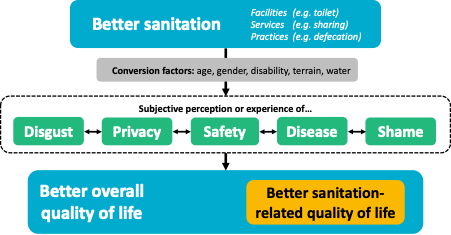
As a concept, “sanitation-related quality of life” is defined as the subset of overall quality of life which is directly affected by sanitation practices or services.
One validated measure of this concept is the SanQoL-5 index, which captures people’s experience of sanitation in a multi-dimensional way with 5 short questions.
The validity and reliability of SanQoL-5 have been demonstrated in a six-country study (Ethiopia, India, Kenya, Malawi, Mozambique, Zambia) in both urban or rural settings (Akter al et., 2025).
There are 5 questions in the SanQoL-5, one for each of privacy, disgust, safety, shame, and disease. The questions focus on how often people experienced feelings or worries in relation to those five attributes in the past 30 days. Responses are invited on a three-level frequency scale (always, sometimes, never) where “always” is bad and “never” is good. The quality of life theory underpinning SanQoL-5 is Sen’s capability approach, which focuses on what people value in having a good life.
| Attribute | Question | Responses |
| Disgust | How often do you feel disgusted while using the toilet*? | Always Sometimes Never |
| Disease | How often do you worry that the toilet spreads diseases? | |
| Privacy | How often do you worry about being seen while using the toilet? | |
| Shame | How often do you feel ashamed about using the toilet? | |
| Safety | How often do you feel unsafe while using the toilet? |
Responses are combined into a weighted index ranging from 0.0 (worst possible) and 1.0 (best possible). For example, someone’s level of SanQoL-5 might be 0.42 before upgrading their toilet and 0.69 afterwards. This weighting process is what makes SanQoL-5 powerful for various applications. Because the weights are elicited from people themselves (see here), the SanQoL-5 index represents the value of sanitation to people.
SanQoL-5 can be used to monitor and evaluate programmes, for needs assessment in baseline studies, or to measure differences over time or between groups.
If you have questions like “What is quality of life?”, and “When should I use SanQoL-5, and when another scale or index?” then check the FAQ.
 SanQoL-5 index